


Putter Distance Control: Drills & At-Home Setups
Putter distance control isn’t talent—it’s a trainable skill. These simple drills and at-home setups will help you groove tempo, sharpen feel, and lag it closer all winter long.
Distance control on the greens can be developed. It’s not an “either you’ve got it or you don’t” thing. It’s a learned skill.
And the winter is the perfect time to hone your putting distance control.
True, outdoors on a real green is an ideal place to practice putting, especially the touch and judgement required for lag putting.
But you can get a lot of good long-putt work done even indoors with limited space.
Whether your course is closed for winter, you’re looking to get some reps in using a golf simulator, or you just want to get on the grind in your living room with the TV going in the background, this post is for anyone who wants to sharpen their putter distance control.
I’m not a golf coach. And I’m not a putting guru. Far from either. But I’ve done the research to find what the real coaches and real gurus all fall back on. These are the tried-and-tested truisms of better putting.
Why Putter Distance Control Matters
The late short-game guru Dave Pelz said that dispersion patterns are typically larger front-to-back than they are left-to-right.
That means you’re more likely to miss putts by rolling them too far or leaving them short than you are by missing left or right.
Don’t get me wrong. If you’re like me, left and right are always in play. But the point is that distance control may matter even more than you already thought.
Get the speed right and you’ve got a chance even if your read is slightly off. Nail the line but leave it 10 feet short, and you’re facing a stressful second putt.
So, the key is shrinking that front-to-back dispersion that’s going to mean fewer three-putts, more stress-free two-putts, and lower scores.
But you probably already knew that. The question is, how do you do it?
Make Tempo Your Foundation
Tempo and distance control go together to the point that they’re almost synonymous. Repeatable tempo is almost a prerequisite to consistently successful lag putting.
A consistent putting stroke works like a pendulum. The secret is rhythm and stroke size, not trying to muscle putts or baby them.
If you’ve got a smooth, repeatable, comfortable, innate tempo, distance becomes about stroke length. The longer the putt, the longer the stroke. Still with a smooth, repeatable tempo. And for shorter putts, the stroke length shortens but the tempo and rhythm remain.
5 Putting Distance Control Drills You Can Do Anywhere
The Metronome Drill

Download a free metronome app. And get to work just like you did when you were learning piano or violin.
Just as you assume, the idea here is to pick a speed and match your putting stroke to that tempo. Take the putter back on beat one, and match impact with beat two. Tour pros typically putt with a tempo between 72 and 80 beats per minute.
Practice this drill with all kinds of different length putts. Understand that your tempo should stay the same. It’s the length of your stroke that should change.
After a few sessions, you won’t need the metronome. A mental “one-two” count will probably do the job.
The Ladder Drill
This is the gold standard. PGA Tour pros use it. And you can use it in your living room.
Place a tee or marker at three-foot intervals on your putting mat or carpet. Putt balls to each marker. You don’t have to be perfect. Just try to finish within a foot of each target.
The goal, once again, is to maintain your tempo even with the different-length strokes required to cover the different distances. A 3-foot putt gets a short backswing. A 9-footer gets a considerably longer one. But the rhythm doesn’t change.
Eyes-Closed Putting
It may sound gimmicky, but putting with your eyes closed is a great way to develop touch and feel.
Look at your target, get your line, then close your eyes before you start the stroke. Make your stroke. Then, before opening your eyes, predict whether the ball finished short, long, or perfect.
This forces you to rely on feel rather than your eyes.
Incremental Distance Drill
This one’s similar to the Ladder Drill. If it’s too similar, mix up the distance increments for both drills.
Set balls at three-foot increments from the hole or end of your mat. Start short. Once you nail that distance, move back 3 feet. If you fail at any station, stay there until you succeed. You get the idea.
This calibrates stroke length relative to distance. It’s boring, but it works.
Three-Ball Distance Matching
If you’ve got a large enough space (or outdoors), set up at about 20 feet. Hit your first ball with a smooth tempo, and don’t worry about where it finishes.
Now hit two more, trying to match that exact distance.
If you can’t hit three balls the same distance, your tempo or impact location needs work.
Add the Power of Data with Golf Simulator Putting Practice
If you’ve got access to a golf simulator with putting, you’ve got a serious training tool.
Golf simulator putting sometimes gets a bad rap because with a lot of launch monitors and sim software, it ends up being the least realistic part of the simulated golf experience. It’s also usually the least fun part.
But if you’re ready to grind, even if it’s boring, and you’re ready to put in the work of studying your data and gaining an understanding of what it’s telling you about your putting stroke, there’s a lot of opportunity for you.

The Exputt RG is a great example. This is a $469 putting-only simulator that absolutely can help you improve. When I tested it, I was surprised by how useful it was for distance control.
You’re always putting from the same spot on a flat 44-inch mat into a foam stopper. That sounds boring, but the accompanying camera tracks your stroke and shows you ball speed, face angle, launch angle, and tempo for every putt.
You can practice straight putts from 5 to 50 feet and see exactly how your stroke length correlates to distance. The software lets you set specific distances or randomize them.
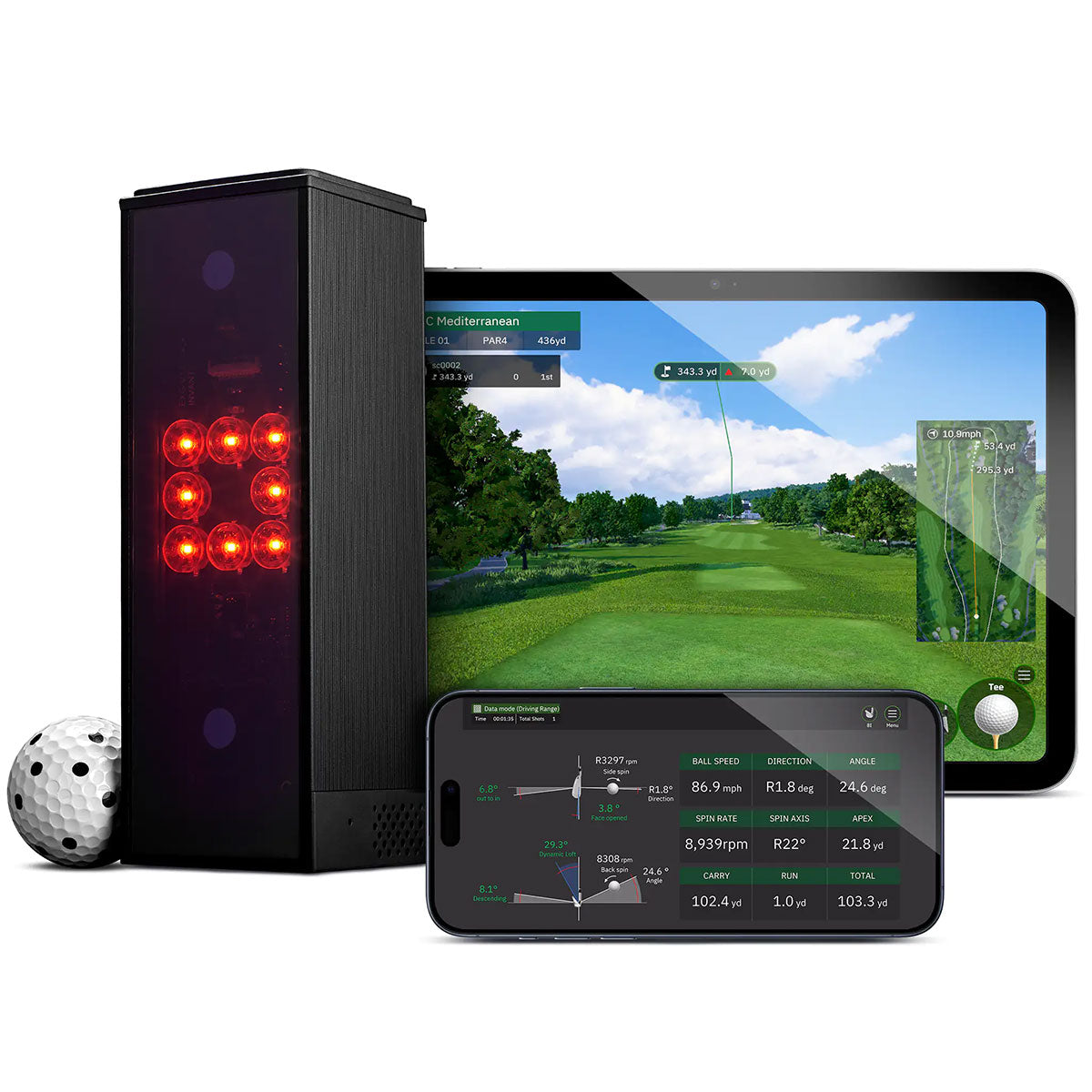
The Square golf launch monitor is another great option. It reads putts and includes a Putting Practice mode where you can choose specific lengths, random distances, or increasing distances, plus select different green speeds.
After each putt, you get ball speed, launch direction, distance rolled, and distance remaining.

If you’ve got a higher-end setup like a Foresight GC3, you can access even more data. And with the top-tier units, you can get everything from skid rate to RPMs at full roll.
No matter which simulator option you choose, adding data to what you’re seeing and feeling can make the whole thing click faster and ingrain deeper.
You Can Improve Your Putter Distance Control, Starting This Winter
Distance control is totally trainable. This is a learned skill, and you can get about as good at it as you want to.
Remember that tempo is your foundation. Groove that rhythm.
After that, it’s all about stroke length. And indoor practice with a quality mat or simulator gives you the reps to build muscle memory. Yes, you’ll of course need to account for the slopes and speeds of the actual outdoor greens you’re playing, but having an ingrained, rock-solid tempo makes adapting to those varying conditions so much easier.
Work the drills and commit to the process of improving.
It can get a little boring, sure. But when peak golf season arrives, you’ll hit the green with a ton more confidence knowing you can lag it close enough from anywhere. And you know how much that matters when you’re trying to score your best.
Nothing boring about that.
About PlayBetter Golf Reviewer Marc Sheforgen
Marc Sheforgen is a golf writer whose passion for the game far exceeds his ability to play it well. Marc covers all things golf, from product reviews and equipment recommendations to event coverage and tournament analysis. When he’s not playing, watching, or writing about golf, he enjoys traveling (often golf-related), youth sports coaching, volunteering, and record collecting.
 Square Golf Launch Monitor & SimulatorFrom $699.99 |  FlightScope Mevo Gen2 Golf Launch MonitorFrom $1,299.00 |  |  ProTee VX Golf Launch Monitor$6,500.00 |  Foresight GCQuad Golf Launch Monitor & SimulatorFrom $15,999.00 |  | |
|---|---|---|---|---|---|---|
Review Link |
|
|
|
|
|
|
Overall Rating (Out of 10) |
|
|
|
—
|
|
—
|
Ease of Setup |
|
|
|
—
|
|
—
|
Data |
|
|
|
—
|
|
—
|
Accuracy |
|
|
|
—
|
|
—
|
Simulation Quality |
|
|
|
—
|
|
—
|
Price |
|
—
|
|
—
|
|
—
|
Product |
|
|
|
|
|
|
Basic Data (Driving Range) |
|
|
|
|
|
|
Advanced Data & Features |
|
|
|
|
|
|
Built-In Simulation |
|
|
|
|
|
|
Product |
|
|
|
|
|
|
3rd Party Connector Fee |
|
|
|
|
|
|
GS Pro |
|
|
|
|
|
|
Awesome Golf |
|
|
|
|
|
|
E6 Connect |
|
|
|
|
|
|
E6 Apex |
|
|
|
|
|
|
The Golf Club |
|
|
|
|
|
|
WGT |
|
|
|
|
|
|
Creative Golf |
|
|
|
|
|
|
FSX |
|
|
|
—
|
|
|
Pro Tee |
|
|
|
|
|
|
Home Tee Hero |
|
|
|
|
|
|
Product |
|
|
|
|
|
|
Ball Speed |
|
|
|
|
|
|
Launch Angle (Vertical) |
|
|
|
|
|
|
Launch Direction (a.k.a. Side Angle/Horizontal Launch Angle) |
|
|
|
|
|
|
Spin Rate (Total Spin) |
|
|
|
|
|
|
Spin Axis (Sometimes Listed as Side Spin/Spin Tilt Axis) |
|
|
|
|
|
|
Apex Height (a.k.a. Peak Height) |
|
|
|
|
|
|
Flight Time |
|
|
|
|
|
|
Descent Angle (a.k.a. Landing Angle, Vertical Descent Angle) |
|
|
|
|
|
|
Carry Distance |
|
|
|
|
|
|
Total Distance |
|
|
|
|
|
|
Roll Distance (a.k.a. Run) |
|
|
|
|
|
|
Offline from Target (a.k.a. Deviation Distance/Side Total/Dispersion |
|
|
|
|
|
|
Curve/Shot Shape (a.k.a. Ball Flight Type, Shot Type) |
|
|
|
|
|
|
Clubhead Speed |
|
|
|
|
|
|
Smash Factor |
|
|
|
|
|
|
Angle of Attack |
|
|
|
|
|
|
Club Path |
|
|
|
|
|
|
Face Angle |
|
|
|
|
|
|
Face to Path |
|
|
|
|
|
|
Dynamic Loft |
|
|
|
|
|
|
Spin Loft |
|
|
|
|
|
|
Loft/Lie |
|
|
|
|
|
|
Closure Rate |
|
|
|
|
|
|
Low Point |
|
|
|
|
|
|
Putting Analysis |
|
|
|
|
|
|
Product |
|
|
|
|
|
|
Room Depth Required |
|
|
|
|
|
|
Portable |
|
|
|
|
|
|
Outside Use |
|
|
|
|
|
|
Built-In Display |
|
|
|
|
|
|
Camera-Based or Radar |
|
|
|
|
|
|
Floor-Based or Overhead |
|
|
|
|
|
|
Left/Right Handed Friendly |
|
|
|
|
|
|
Left/Right Adjustment Required |
|
|
|
|
|
|
Requires Stickers (Ball/Club) |
|
|
|
|
|
|
Video Playback - Swing |
|
|
|
|
|
|
Shipping Speed (PlayBetter) |
|
|
|
|
|
|
Return Policy (PlayBetter) |
|
|
|
|
|
|
Available on PlayBetter.com |
|
|
|
|
|
|