


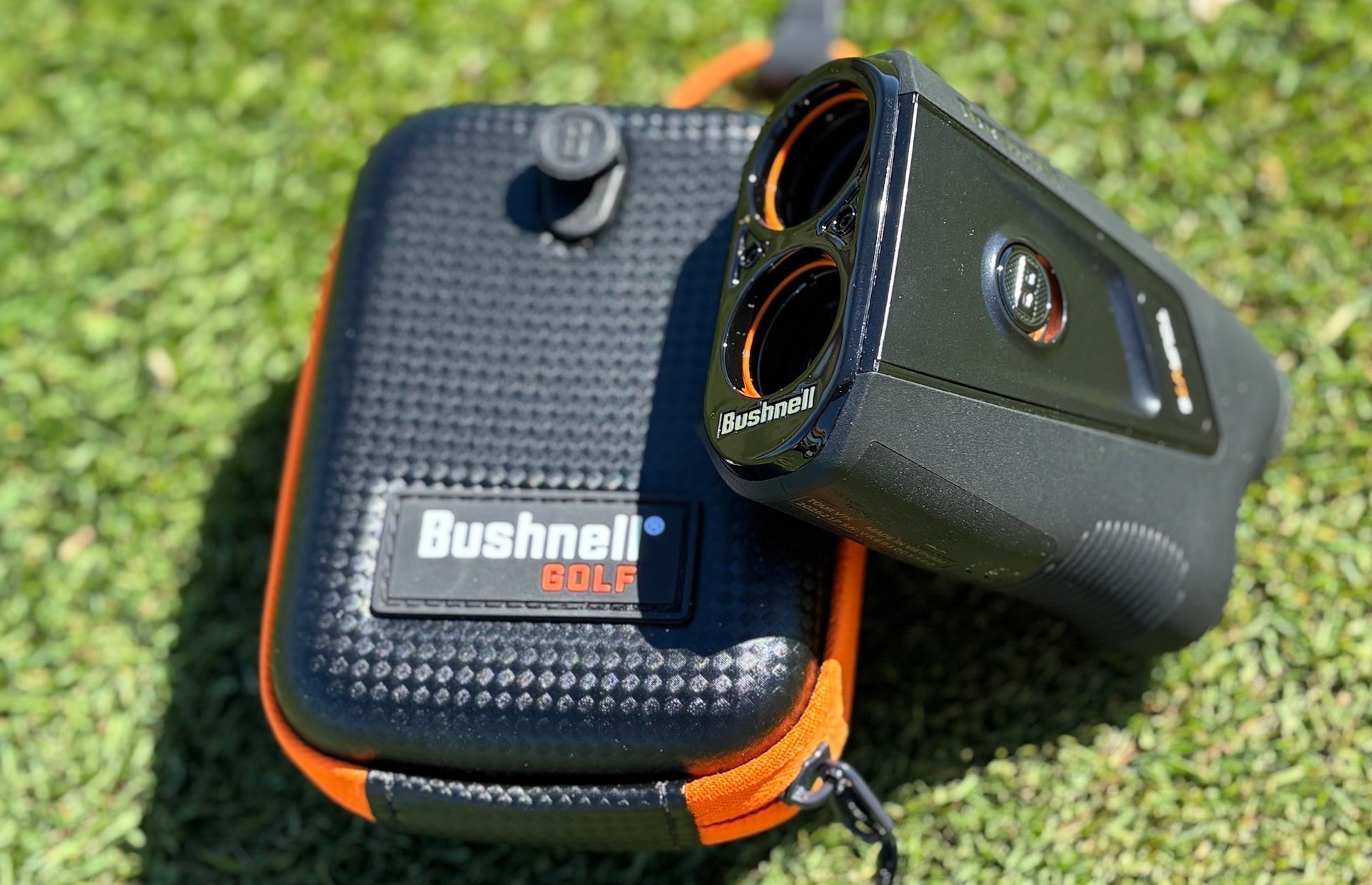
Bushnell Tour V7 Shift Rangefinder Review: Sneaky Good
The Bushnell Tour V7 Shift might not wow you at first glance—but give it a round, and it’s hard not to be impressed. With smart upgrades like dual-color OLED and LINK-enabled tech, it quietly becomes one of the best values in golf.
When Bushnell first unveiled the Tour V7 Shift, I wasn’t sure there was much of a story here. After using it, however, I’ve changed my tune entirely. I actually can’t remember a golf product where I’ve gone from so disinterested to so legitimately excited.
The Tour V7 Shift is that kind of rangefinder. It’s sneaky good.
On the surface, it looks like just another in a long line of Bushnell lasers. But investigate a bit, and the features start presenting themselves in ways that make you realize you’re holding something special.
Things like the dual-color OLED display that gives you your slope-adjusted number in a different color. It took me a minute to appreciate the usefulness. Or the new range recall feature that lets you call up your last yardage with one button press. You’ve got to live it to really grasp it.
I’ve reviewed plenty of golf products that I’ve loved from the initial unboxing. My appreciation for the Tour V7 Shift came on a little slower. But I’m definitely there now.
So how did I go from unimpressed to bowled over? Let me walk you through all of it.
A Bit of Bushnell Tour V-Series Context

Before we get into what's new, it's worth spending a minute on how we got here.
Bushnell didn't just enter the golf rangefinder category. They pretty much created it. The PinSeeker 2000 back in 2001 was one of the first widely used golf laser rangefinders, and the brand has been setting the standard ever since.
The Tour V-series has been the sweet spot in the Bushnell lineup for years. Not the budget option. Not the flagship. It’s the smart choice for the serious golfer who wants tour-trusted performance without paying for every bell and whistle they may never use.
Each generation has added something meaningful.
Looking at the most recent iterations, the V4 gave us JOLT vibration feedback. The V5 brought improved optics and slope technology. The V6 upgraded the electronics, pushed the flagging range to 500-plus yards, added IPX6 weather resistance, and enhanced the Visual JOLT system with a more prominent red ring flash.
The V7 Shift continues that tradition. And in my view, it makes the biggest generational leap of them all.
And the thing that’s coolest about this is that Bushnell rolled out this upgraded V7 Shift without raising the price. It still costs the same $399.99 as what the V6 Shift debuted at.
The “Just Right” Tour V7 Shift Design and Build

One thing I love about the V7 is the same thing I loved about the V6. The hand feel, the weight, and the overall ergonomics are outstanding.
Bushnell’s Pro X3+ LINK is an awesome rangefinder, of course. At $600, it’d better be. But it's also massive. I honestly think it’s too big and kind of gets in the way and is harder to fit into pockets.
On the other Bushnell end, you've got the A1-Slope, which is compact and light, but almost to a fault. It’s tiny. Way too small for a lot of golfers.
The V7 Shift lands right in the middle. The chassis appears to be essentially identical to the outgoing V6 Shift, which I consider a win. Bushnell got this form factor right, and they didn't mess with it.
The all-black design with subtle orange accenting I think looks really good. You’ve got orange pops around the lens ring, on the slope switch, on the power button. Nothing garish. It’s a very stealth rangefinder. Probably makes it easier to lose, but it definitely looks way cool in the meantime.
Build quality is everything that’s become synonymous with Bushnell. Solid, substantial, great grip and feel. It’s 9 ounces, which I again find to be just right.
Of course, the V7 Shift includes the classic Bushnell BITE cart magnet, which is still the strongest in the business.

It also comes with the standard style Bushnell rangefinder carrying case. This is another one of those things that Bushnell pioneered and refined and that everyone has copied. But the texture on the V7 Shift model is a bit more rubberized. It feels a little cheaper than the more canvas-feeling style that I’m used to with Bushnell. I also will say that this new more rubberized, plasticy material smells terrible. It’s nasty! So hopefully that will fade with time.
For battery, the V7 runs on a CR2 rather than USB-C recharging. I like to replace mine at the beginning of the season and call it good, so I prefer a non-rechargeable rangefinder.
No Surprises With Optics and Accuracy
I’ll get to the dual-color OLED display in a minute, but first you’ve got your 6x magnification, which is the same as the rest of the Tour V-Series line. It’s a 24mm objective lens, fully multi-coated, with a field of view of 330 feet at 1,000 yards.
Those are the numbers. On the course, what I can say is that the optics are as close to perfect short of the 7x magnification class as you can get. It looks really, really good.

The V7 Shift is a fast, decisive rangefinder, which I really like. It makes up its mind. When it isn’t locked onto the flag or something very solid and similar to it, it will not vibrate. And if it doesn’t have something good to grab onto, it won’t show a yardage at all. But as soon as you do hit the pin, you get a very confidence-inspiring strong vibration with a visual red ring around the perimeter of the eyepiece. There’s no second-guessing with this rangefinder.
A lot of cheaper options are a little more hair-trigger. They’ll show you a yardage pretty much anytime you hit the button, and the ones that vibrate will give you that vibration confirmation even when they’ve hit nothing more than a random twig in between you and your target. So you’re always kind of left wondering and second guessing whether you really locked onto the pin. That is a complete non-issue with theTour V7 Shift.
Ranging accuracy is rated at plus or minus one yard, and I had no issues in real-world rounds. It’s very consistent and reliable. Another Bushnell hallmark.
Slope-Adjusted Number Now In Green

This is definitely where my pre-release skepticism was most misplaced.
When I first got the product specs ahead of the PGA Show, I couldn’t quite envision how having your slope-adjusted number in green and your non-slope number in red would matter at all.
But now I love it. Your eye is drawn immediately to one number, the slope-adjusted number. That’s the one I want most often. And when I want to cross-check it against the real number and want to see how many yards up or downhill it’s playing, that information is all there too, but it’s in red. It’s like it’s sitting in the background until you call it forward.
I just really like this feature much more than I anticipated. Bushnell calls it their Slope First Technology, and the Tour V7 Shift is the debut. This is Bushnell’s first dual-color OLED display, and I think they deployed that second color brilliantly.
Your eye is just immediately drawn to that contrasting green number. It’s subtle, but it really does just make it that much simpler and cleaner to get your number quickly.
Obviously, if you’re playing in a tournament where slope isn’t permitted, the Slope-Switch is right there on the side of the device. Flip it to the off position, and you won’t see the slope-adjusted information in the viewfinder.
The OLED display also performs well across lighting conditions. I didn’t notice any issues in bright sun or overcast conditions.
There’s also a couple of other things going on in the Tour V7 Shift viewfinder if you’re playing while connected to the app. After all, this is a Bluetooth-enabled rangefinder. I’ll get to the advantages that unlocks in just a minute.
New Yardage Range Recall Feature Surprisingly Useful

This is another feature that I found easy to dismiss on the initial spec sheet. I just wasn’t thinking very clearly about why I would care about a yardage I had shot after I was done shooting it.
The concept is simple. You press the Mode button on top of the unit and it retrieves the last distance you measured, even if you've moved since you took the reading. No re-ranging required.
Turns out, that can really come in handy.
I still don’t find this to be as exciting of a feature as the dual-color OLED display with the green slope-adjusted yardage number, nor as exciting as the LINK-Enabled connectivity we’ll talk about in just a minute. But the new Range Recall feature does have its use cases.
Cart-path only days where you get back to your clubs and can’t remember the number you shot. Or times where you shoot your number and then get distracted and aren’t sure you’re remembering the right yardage. All kinds of things that actually do come up regularly in rounds of golf.
Like I said, I don’t see this as a headline feature. Then again, remember that all of these add-on innovations are coming without a price increase.
Now $400 Entry Point to LINK-Enabled Technology
Foresight Sports and Bushnell have pioneered so many technologies and features that have become industry standards. Among their latest copied innovations is a connected ecosystem whereby a golfer can get personalized club recommendations in their rangefinder that are based on yardages they got while bag mapping with their launch monitor.
Foresight and Bushnell debuted this as LINK-Enabled technology. But until now, the only way in was through the top-end Pro X3+ LINK rangefinder.
Now, we get that same feature access with the $400 Tour V7 Shift. The reason that’s cause for excitement is because the feature is legitimately awesome.
You do of course need a Bushnell or Foresight launch monitor. Meaning at least a Launch Pro. But if you’ve got that and a Tour V7 Shift, you can do a simple bag mapping session with your launch monitor and the Foresight app. You then sync that information with the Bushnell Golf app and connect the V7 Shift via Bluetooth.
Out on the course, when you range a flag, the rangefinder displays two club recommendations in the reticle based on your actual numbers. You get a “+” option and a “-” option. So that could be a soft swing with the longer club or a committed swing with the shorter one. Or maybe it helps confirm your decision based on your lie or the weather conditions.
The way that Foresight and Bushnell have pulled this off is really slick. I know it sounds cumbersome to be involved with a launch monitor, two apps, and a rangefinder. But getting started with this is actually incredibly simple. Your biggest time commitment is with the bag mapping, but you’ve got the option to only hit a few clubs and to only hit five shots with each. Of course, the more in-depth you go, the more useful your data will be.
I don’t think that the Tour V7 Shift needs the LINK-Enabled feature to be worth $400. Remember, the outgoing Tour V6 Shift, which didn’t have LINK and didn’t have all the other new features the V7 introduces, was also $400.
But if you do have a Bushnell or Foresight launch monitor, it is absolutely worth owning this rangefinder to take advantage of that feature. Getting club recommendations out on the course can really help with indecision. And getting two recommendations is great because we’re almost always deciding between two clubs.
Who Should Buy the Bushnell Tour V7 Shift Rangefinder

Let’s face it, the rangefinder market is crowded. I think that’s why Bushnell didn’t raise the price with this new model. Things are very competitive right now.
But we’re getting a hell of a lot for $400 with the Tour V7 Shift. I personally think this is the biggest single leap between Tour V-Series iterations. They’ve added a lot of meaningful stuff here, and the fact that the price stays the same is actually pretty remarkable.
I love the new dual-color OLED display with the slope-adjusted number in green. I didn’t even know that I would care at all about this feature. Now, I actually think it’s one of my favorites.
I can’t make quite as bold of a claim for the new Range Recall feature that lets you get your last yardage with a single button press. But I do see its value and I can see how it will come up pretty regularly.
To now get access to the whole Foresight/Bushnell interconnected world via the $400 Tour V7 Shift rather than the $600 Pro X3+ is a big deal. That’s a flagship feature, and they’ve essentially now brought the entry point price down by $200.
Of course, I also love the overall feel, fit, and finish of the Tour V7 Shift. I don’t think it’s any different than the V6 Shift. And that’s fine by me. That design works perfectly well.
You definitely don’t have to spend $400 to get a quality rangefinder. Especially if all you really want is accurate yardages.
But the Tour V7 Shift does a lot more than just the basics. It’s delivering truly top-shelf features while staying at a mid-tier price point.
I might not have seen this rangefinder’s value initially, but it’s very obvious to me now. The Tour V7 Shift is going to be a Bushnell classic.